

Digital Holography Market Size to Reach USD 22.48 Billion by 2035, Growing at a 15.62% CAGR
Digital Holography Market
Digital Holography Market Size, Share and Research Report By Application (Medical Imaging, Data Storage, Microscopy, Particle Characterization), By Technology
The Digital Holography Market is expanding as advanced imaging technologies enable high-precision 3D visualization, measurement, and analysis across healthcare, industrial.”
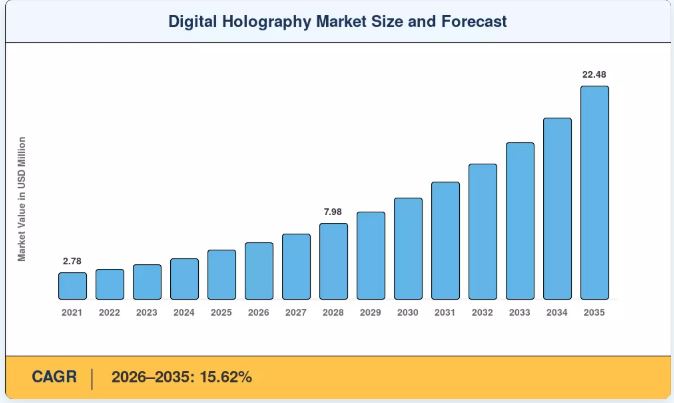
PARIS, PARIS, FRANCE, June 17, 2026 /EINPresswire.com/ -- The Global Digital Holography market was valued at USD 5.22 billion in 2025 and is projected to grow from USD 5.97 billion in 2026 to USD 22.48 billion by 2035, exhibiting a compound annual growth rate (CAGR) of 15.62% during the forecast period. Digital holography the science of recording, reconstructing, and analyzing three-dimensional optical wavefronts using digital sensors and computational algorithms is transitioning rapidly from laboratory instrumentation to a commercially deployable platform technology. — Market Research Future (MRFR)
Its ability to deliver label-free, non-invasive, real-time three-dimensional measurement and visualization is generating strong and growing demand across medical imaging, industrial non-destructive testing, semiconductor metrology, aerospace inspection, security authentication, and immersive display applications.
The convergence of several enabling technologies is dramatically expanding digital holography’s addressable market. High-resolution CMOS and CCD image sensors, high-coherence laser sources at accessible price points, GPU-accelerated hologram reconstruction algorithms, and cloud-based computational imaging platforms are collectively reducing the cost and complexity of digital holographic systems. Simultaneously, the explosive growth of augmented reality, virtual reality, and mixed reality platforms is creating a vast new commercial frontier for holographic display technology that promises to transform entertainment, education, surgical planning, remote collaboration, and retail visualization.
Get Full PDF Sample Copy of Report: (Including Full TOC, List of Tables & Figures, Chart) @
https://www.marketresearchfuture.com/sample_request/4210
➤How Significant Is the Digital Holography Market’s Growth?
The digital holography market has sustained impressive momentum, growing from USD 0.806 billion in 2024 to a projected USD 3.8 billion by 2035 — representing more than a four-fold expansion over the forecast decade. This trajectory, anchored by a 15.14% CAGR, reflects both the deepening penetration of existing applications and the emergence of entirely new use cases that did not exist at commercial scale a decade ago.
Medical imaging remains the largest and most mature application segment, with digital holographic microscopy enabling quantitative, label-free analysis of living cells, blood cells, and tissue samples with unprecedented spatial resolution and without the phototoxicity risks associated with fluorescence staining. The medical imaging segment is projected to reach USD 1.5 billion by 2035, driven by adoption in oncology diagnostics, haematology, drug discovery, and regenerative medicine research.
Hardware components currently dominate the market with over 60% revenue share, reflecting the capital-intensive nature of holographic imaging system procurement, while the software segment is growing at a notably faster pace as AI-powered reconstruction and analysis platforms increasingly differentiate vendor offerings.
➤What Does the Future Hold for the Digital Holography Market?
Artificial intelligence and machine learning integration represents the most transformative near-term development trajectory for digital holography. Deep learning algorithms are enabling real-time hologram reconstruction at speeds orders of magnitude faster than conventional iterative numerical methods, making AI-accelerated holographic imaging viable for clinical diagnostics, high-throughput pharmaceutical screening, and inline industrial inspection applications that demand sub-second analysis of complex three-dimensional data sets.
Holographic telepresence and three-dimensional display technology represent the market’s most expansive long-term growth frontier. As 5G network infrastructure matures and the Versatile Video Coding (VVC/H.266) standard significantly reduces holographic data transmission bandwidth requirements, real-time volumetric video communication is advancing from research prototype toward commercial deployment.
Medical applications including holographic surgical navigation, remote consultation with floating anatomical models, and cardiac catheterization guidance using real-time 3D holograms — pioneered by companies like RealView Imaging are among the most clinically compelling early commercial applications.
Industrial metrology and non-destructive testing represent a third significant growth vector, with digital holographic interferometry providing nanometre-precision surface deformation, vibration, and strain analysis for aerospace components, turbine blades, microelectronics, and precision optics manufacturing. The semiconductor industry’s relentless drive toward smaller geometries and the demands of advanced packaging inspection are generating growing procurement of holographic metrology instruments capable of detecting sub-wavelength surface defects across wafer and substrate surfaces.
➤Who Are the Key Players in the Digital Holography Market?
The digital holography market features a diverse competitive landscape spanning precision optics and photonics specialists, imaging technology companies, AR/VR hardware developers, and research-driven instrumentation providers. Key participants identified by MRFR shaping the competitive ecosystem include:
✿Lyncee Tec SA (Switzerland) — the market’s leading specialist in digital holographic microscopy, providing quantitative phase imaging instruments for life sciences, semiconductor inspection, and material characterization applications, with products recognized for high-resolution, real-time 3D cell imaging capabilities.
✿Zebra Imaging Inc. (United States) — a pioneer in holographic print technology and digital light field rendering systems, with established applications in geospatial visualization, defense mission planning, and architectural design communication.
✿Eon Reality, Inc. (United States) — a leading developer of augmented and virtual reality platforms incorporating holographic display elements, serving education, workforce training, and enterprise visualization markets globally.
✿Holoxica Ltd. (United Kingdom) — a specialist in medical and scientific holographic display systems, pioneering volumetric 3D holographic visualization for surgical planning, medical education, and complex data rendering applications.
✿LEIA Inc. (United States) — a developer of diffractive lightfield display technology enabling glasses-free 3D holographic content experiences on mobile devices, tablets, and automotive displays.
✿Geola Digital UAB (Lithuania) — a manufacturer of holographic recording systems and pulsed laser holography equipment for industrial, security, and artistic holography production applications.
✿Ovizio Imaging Systems NV/SA (Belgium) — a specialist in digital holographic microscopy platforms for pharmaceutical bioprocess monitoring, cell counting, and viability analysis in bioreactor environments.
✿Jasper Display Corporation (Taiwan) — a provider of silicon-based liquid crystal on silicon (LCoS) microdisplay chips and optical engines for spatial light modulator applications in holographic display and projection systems.
✿RealView Imaging Ltd. (Israel) — a medical holographic imaging company developing interactive, patient-specific 3D holographic visualizations for cardiac catheterization, interventional procedures, and surgical navigation.
✿Phase Holographic Imaging AB (PHI) (Sweden) — a developer of holomonitor technology for non-invasive, quantitative 3D cell monitoring in life sciences research, drug development, and cell therapy manufacturing.
✿Hamamatsu Photonics K.K. (Japan) — a world-leading photonic device manufacturer supplying high-performance image sensors, laser sources, and spatial light modulators that form the core hardware components of advanced digital holographic imaging systems.
✿Carl Zeiss AG (Germany) — a global precision optics leader integrating digital holographic microscopy capabilities within its broad scientific and industrial imaging instrument portfolio, serving life sciences, semiconductor, and materials research markets.
The competitive landscape is moderately fragmented, with the top five vendors controlling approximately 35% of market revenue in 2024. Strategic partnerships between optics specialists, AI software developers, and clinical institutions are reshaping the innovation trajectory across the market.
➤What Are the Emerging Trends in the Digital Holography Market?
Several transformational trends are redefining the digital holography market’s evolution through 2035:
AI-Accelerated Hologram Reconstruction: Deep learning neural networks are replacing computationally intensive iterative phase-retrieval algorithms, enabling real-time holographic reconstruction at video frame rates. This breakthrough is making AI-powered digital holography viable for live clinical diagnostics, high-throughput screening, and dynamic industrial inspection applications.
Holographic AR/VR Display Convergence: The integration of computer-generated holography (CGH) into augmented and mixed reality headsets is advancing from research prototype toward commercial hardware platforms. True holographic displays — producing correct focus cues and eliminating vergence-accommodation conflict — are a defining competitive objective among major AR hardware developers.
Medical Holographic Visualization Expansion: Growing adoption of patient-specific holographic surgical planning, holographic cardiac navigation, and real-time 3D anatomy visualization in operating theatres and catheterization labs is establishing medical holography as a premium clinical tool. University medical centers and leading hospitals are investing in holographic visualization infrastructure for complex interventional procedures.
Semiconductor & Advanced Packaging Metrology Demand: The transition to 3nm and sub-3nm semiconductor process nodes, combined with heterogeneous chiplet packaging architectures, is driving adoption of digital holographic interferometry for wafer-level defect detection, die-to-substrate alignment verification, and advanced packaging inspection at nanometre-precision scales.
Holographic Security & Anti-Counterfeiting Innovation: Digital holography’s ability to encode machine-readable authentication information invisible to the naked eye is driving adoption in high-security identity documents, pharmaceutical packaging, luxury goods authentication, and currency security features, creating a growing commercial market for holographic security label production systems.
Portable & Miniaturized Holographic Instruments: Advances in compact laser diodes, miniaturized CMOS sensors, and on-chip holographic processing are enabling portable digital holographic microscopes and inspection tools for point-of-care diagnostics, field-deployable quality control, and wearable sensing applications that were previously confined to laboratory environments.
Get access to the full description of the report @
https://www.marketresearchfuture.com/reports/digital-holography-market-4210
➤How Is the Digital Holography Market Segmented?
The digital holography market report provides a comprehensive segmentation framework:
By Application: Medical Imaging, Holographic Display, Holographic Telepresence, Industrial Metrology & Non-Destructive Testing, Security & Authentication, Others
By Technology: Digital Holographic Microscopy (DHM), Digital Holographic Interferometry (DHI), Computer-Generated Holography (CGH), Others
By End Use: Healthcare & Life Sciences, Electronics & Semiconductors, Aerospace & Defense, Industrial Manufacturing, Media & Entertainment, Others
By Component: Hardware (Cameras/Sensors, Lasers, Spatial Light Modulators, Beam Splitters), Software, Services
By Region: North America, Europe, Asia-Pacific, South America, Middle East & Africa
➤What Are the Regional Insights from the Digital Holography Market?
North America commands the largest share of the global digital holography market, accounting for approximately 33–42% of revenues. The United States is the primary driver, home to leading holographic display companies including Leia Inc., Eon Reality, and Zebra Imaging, alongside a deep ecosystem of defense research programs investing in holographic LiDAR, reconnaissance, and mission planning visualization technologies. National Institutes of Health (NIH) funding for holographic microscopy in biomedical research and DARPA programs advancing holographic sensor technologies reinforce North America’s leadership position.
Europe holds the second-largest regional share, anchored by a world-class precision optics and photonics manufacturing ecosystem. Switzerland’s Lyncee Tec, Sweden’s Phase Holographic Imaging, Belgium’s Ovizio Imaging Systems, Germany’s Zeiss and Fraunhofer Institute for Applied Optics, and the United Kingdom’s Holoxica collectively make Europe the global center of gravity for scientific and medical digital holographic instrument development. Germany’s advanced manufacturing base is also driving adoption of holographic interferometry for precision industrial metrology in automotive and aerospace component inspection.
Asia-Pacific is the fastest-growing regional market for digital holography, propelled by Japan’s USD 215 million government grant program supporting label-free holographic cell analysis, South Korea’s investments in holographic display technology for consumer electronics and automotive HUD applications, and China’s rapid expansion of holographic advertising, retail visualization, and smart city display installations. Taiwan’s Jasper Display Corporation is a globally significant supplier of LCoS microdisplay chips underpinning holographic projection systems worldwide.
South America, the Middle East, and Africa represent nascent but emerging markets for digital holography, with adoption driven primarily by healthcare infrastructure modernization programs, growing semiconductor manufacturing investment in countries such as India and Malaysia, and increasing deployment of holographic security features in government identity document and currency production programs across the regions.
➤➤➤Regional & Country-Level Reports by Market Research Future:
US Digital Holography Market- https://www.marketresearchfuture.com/reports/us-digital-holography-market-15201
➤➤➤ Industry Analysis Reports by Market Research Future:
Vibration Monitoring Market-
https://www.marketresearchfuture.com/reports/vibration-monitoring-market-3932
Eye Tracking Market-
https://www.marketresearchfuture.com/reports/eye-tracking-market-3958
Purpose-Built Backup Appliance Market-
https://www.marketresearchfuture.com/reports/purpose-built-backup-appliance-market-4206
Smart Workplace Market-
https://www.marketresearchfuture.com/reports/smart-workplace-market-4465
Personal Emergency Response Systems Market-
https://www.marketresearchfuture.com/reports/personal-emergency-response-systems-market-4522
Audio Interface Market-
https://www.marketresearchfuture.com/reports/audio-interface-market-4681
Smart Lock Market-
https://www.marketresearchfuture.com/reports/smart-lock-market-4803
Passenger Service System Market-
https://www.marketresearchfuture.com/reports/passenger-service-system-market-5169
Application Specific Integrated Circuit Market-
https://www.marketresearchfuture.com/reports/application-specific-integrated-circuit-market-5611
Optical Sorter Market-
https://www.marketresearchfuture.com/reports/optical-sorter-market-5731
Sagar Kadam
Market Research Future
+ +1 628-258-0071
email us here
Visit us on social media:
LinkedIn
Facebook
X
Legal Disclaimer:
EIN Presswire provides this news content "as is" without warranty of any kind. We do not accept any responsibility or liability for the accuracy, content, images, videos, licenses, completeness, legality, or reliability of the information contained in this article. If you have any complaints or copyright issues related to this article, kindly contact the author above.
