

Mass Flow Controller Market to Reach USD 3.98 Billion by 2035 with 7.12% CAGR Growth
Mass Flow Controller market
Mass Flow Controller Market – Increasing use of automated process control systems across semiconductor, pharmaceutical, and chemical industries is boosting
Mass Flow Controller Market – Increasing use of automated process control systems across semiconductor, pharmaceutical, and chemical industries is boosting the mass flow controller market.”
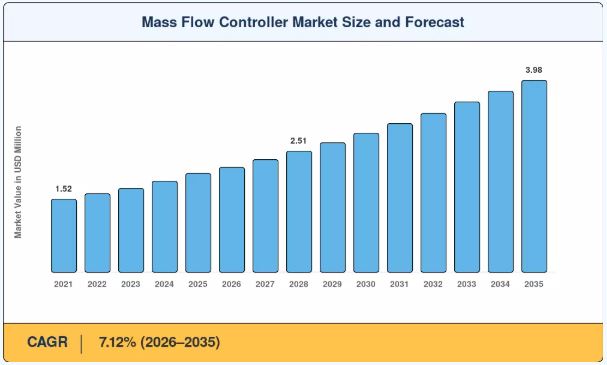
NEW YORK, NY, UNITED STATES, June 22, 2026 /EINPresswire.com/ -- The Mass Flow Controller market reached an estimated USD 2.05 billion in 2025 and is projected to grow from USD 2.18 billion in 2026 to USD 3.98 billion by 2035, registering a compound annual growth rate (CAGR) of 7.12% during the forecast period. Mass flow controllers precision instruments that measure and regulate the flow rate of gases and liquids in industrial and laboratory processes are indispensable enabling technology across semiconductor fabrication, pharmaceutical bioprocessing, chemical manufacturing, and the rapidly expanding renewable energy and green hydrogen sector. — Market Research Future (MRFR)
This expansion is anchored in two converging forces: semiconductor capital-expenditure commitments exceeding USD 400 billion globally through 2030, and tightening emissions regulations that compel industrial facilities to upgrade gas flow rate control infrastructure.
A profound technology transformation is reshaping how industrial facilities manage process gas flow. Legacy rotameter-based systems and manual needle valves once standard in chemical plants and pharmaceutical cleanrooms are being displaced by digital, self-diagnosing thermal mass flow controllers capable of sub-1% accuracy at flow rates below 10 sccm. The US CHIPS and Science Act alone has catalyzed over USD 52 billion in domestic fab investments, each requiring thousands of semiconductor gas flow control units per production line, while European REACH and F-gas regulation updates are accelerating retrofit programs that replace analog meters with networked digital platforms across the continent’s industrial base.
Get Full PDF Sample Copy of Report: (Including Full TOC, List of Tables & Figures, Chart) @
https://www.marketresearchfuture.com/sample_request/4975
➤ How Significant Is the Mass Flow Controller Market’s Growth?
The mass flow controller market’s growth trajectory reflects its position at the intersection of three of the global economy’s most capital-intensive investment cycles semiconductor fabrication, pharmaceutical bioprocessing, and renewable hydrogen infrastructure. Growing from USD 2.05 billion in 2025 to a projected USD 3.98 billion by 2035, the market is on track to nearly double over the forecast decade as MFC precision flow devices transition from a component-supply business into a data-rich, service-oriented ecosystem.
Thermal mass flow controllers commanded the largest revenue share in 2025 at approximately 56.4%, reflecting their dominance in semiconductor gas flow control and chemical dosing applications. Coriolis MFC units are forecast to register a notably faster 10.65% CAGR through 2035, driven by demand for direct mass measurement in biologics and green hydrogen process gas flow management, while pressure-based MFC platforms are gaining traction in high-purity gas delivery for advanced EUV lithography nodes. By end-user industry, semiconductor fabrication accounted for roughly USD 0.79 billion of the market in 2025, reflecting the sector’s outsized capital intensity, while renewable energy and fuel cell applications are poised for a 13.1% CAGR through 2035 the fastest among all end-user verticals.
➤ What Does the Future Hold for the Mass Flow Controller Market?
The semiconductor capital expenditure mega-cycle stands at the center of the market’s near-term growth trajectory. As top chipmakers expand global fabrication facilities, semiconductor capital expenditures continue to average USD 160–180 billion annually, with advanced logic factories requiring hundreds of thermal mass flow controllers for precise precursor gas delivery in CVD, ALD, and etch chambers. The industry’s shift toward next-generation transistor architectures such as gate-all-around nodes at 2nm and below is requiring tighter flow control tolerances, driving high-margin upgrade cycles and raising average selling prices for precision digital flow devices across the market.
Green hydrogen electrolyzer build-out represents a transformative new demand vector reshaping the market’s product mix. The EU’s REPowerEU policy targets 10 million tonnes of domestic renewable hydrogen production by 2030, necessitating a major multi-gigawatt expansion in electrolyzer capacity. Coriolis and thermal mass flow controllers are deployed in megawatt-scale proton exchange membrane (PEM) and alkaline electrolyzer stacks to precisely control hydrogen, oxygen, and water loops to preserve membrane integrity and these hostile electrolysis environments require corrosion-resistant, exotic alloy wetted parts that are driving a clear shift toward high-end, high-margin instrumentation.
Pharmaceutical bioprocessing expansion is generating sustained, structurally durable demand growth. The fast-growing biologics segment of the global pharmaceutical pipeline is driving strong investment in single-use and continuous bioprocessing systems, which require exact gas flow rate control for nitrogen overlay, dissolved oxygen, and CO2 management to preserve cell viability in bioreactors. As contract development and manufacturing organizations (CDMOs) expand global bioreactor capacity, regulatory guidance favoring continuous manufacturing over batch processing is further encouraging the replacement of outdated manual rotameters with digital, audit-trail-ready MFCs across the pharmaceutical manufacturing base.
➤ Who Are the Key Players in the Mass Flow Controller Market?
The mass flow controller market is served by a concentrated group of precision instrumentation specialists with deep semiconductor, industrial process, and analytical measurement expertise. MRFR identifies the following key participants shaping the competitive landscape:
★ Brooks Instrument (a unit of Illinois Tool Works) — a global leader in precision mass flow and pressure control instrumentation, providing thermal and Coriolis mass flow controllers engineered for semiconductor, industrial, and life sciences applications requiring the highest levels of accuracy and repeatability.
★ Horiba Ltd. — a Japanese precision measurement and analytical instrumentation leader, offering a comprehensive portfolio of mass flow controllers for semiconductor process gas control, automotive emissions testing, and scientific research applications
MKS Instruments, Inc. — a major supplier of process control instrumentation and subsystems for semiconductor manufacturing, providing advanced thermal and pressure-based mass flow controllers integrated within broader gas delivery and vacuum process solutions.
★ Bronkhorst High-Tech B.V. — a Netherlands-based specialist in Coriolis and thermal mass flow controllers, with particular strength in low-flow precision instrumentation for laboratory, pharmaceutical, and renewable energy research applications.
★ AZBIL Corporation — a Japanese industrial automation and control instrumentation leader, supplying mass flow controllers and gas flow measurement systems for semiconductor fabrication, chemical processing, and building automation applications.
★ Bürkert Fluid Control Systems — a German fluid control technology specialist providing mass flow controllers and precision valve systems engineered for pharmaceutical, chemical, and food and beverage process applications requiring hygienic and sanitary design standards.
★ Sierra Instruments, Inc. — a US-based manufacturer specializing in thermal mass flow meters and controllers for industrial gas measurement, biogas monitoring, and emissions compliance applications across a broad range of process industries.
★ Pivotal Systems Corporation — an innovator in digital, self-calibrating mass flow controller technology, providing advanced semiconductor gas flow control solutions with integrated diagnostics and predictive maintenance capabilities for next-generation fab environments.
Competitive dynamics in this market are increasingly shaped by the transition toward digital, networked MFC platforms with embedded diagnostics and predictive maintenance capabilities, intensifying price competition from Chinese entrants in standard product categories, and the race among incumbent suppliers to capture high-margin opportunities in green hydrogen, biologics, and EUV lithography applications.
➤ What Are the Emerging Trends in the Mass Flow Controller Market?
Several transformational trends are redefining the mass flow controller market’s evolution through 2035:
Semiconductor Capex Mega-Cycle: Sustained global semiconductor capital expenditure averaging USD 160–180 billion annually, combined with the industry’s transition to gate-all-around transistor architectures at 2nm and below, is driving demand for hundreds of high-precision thermal mass flow controllers per advanced logic fabrication facility, raising both unit volumes and average selling prices across the market.
Green Hydrogen Electrolyzer Build-Out: The EU’s REPowerEU target of 10 million tonnes of domestic renewable hydrogen production by 2030 is driving multi-gigawatt electrolyzer capacity expansion, generating strong demand for corrosion-resistant, exotic alloy mass flow controllers engineered for hostile PEM and alkaline electrolysis environments.
Pharmaceutical Bioprocessing Expansion: Rapid growth in the biologics segment of the global pharmaceutical pipeline is driving investment in single-use and continuous bioprocessing systems, generating sustained demand for digital, audit-trail-ready mass flow controllers that replace legacy manual rotameters in regulated cleanroom environments.
Emissions & Leak-Detection Regulatory Compliance: The US EPA’s finalized methane rule and its Super-Emitter Response Program, alongside expanding European best-available-technology regulations, are compelling oil, gas, and chemical operators to replace unmonitored flow orifices with precise, networked digital mass flow controllers across thousands of industrial sites.
Digital Twin & Predictive Maintenance Adoption: MFC manufacturers are increasingly embedding self-diagnostic sensors, cloud connectivity, and predictive maintenance algorithms within their product platforms, transforming mass flow controllers from passive components into data-generating assets that support digital twin modeling of industrial gas delivery systems.
MFC-as-a-Service & Data Monetization: Leading suppliers are exploring outcome-based service models that bundle mass flow controller hardware with calibration services, predictive maintenance, and performance guarantees, creating new recurring revenue streams and deepening customer relationships beyond traditional one-time equipment sales.
Get access to the full description of the report @
https://www.marketresearchfuture.com/reports/mass-flow-controller-market-4975
➤ How Is the Mass Flow Controller Market Segmented?
The mass flow controller market report provides a comprehensive segmentation framework:
By Material Type: Stainless Steel, Exotic Alloys, Others (Polymer, Ceramic)
By Flow Rate: Low Flow (≤ 100 sccm), Medium Flow (100–1,000 sccm), High Flow (> 1,000 sccm)
By Product Type: Thermal MFC, Coriolis MFC, Pressure-Based MFC, Differential-Pressure MFC
By End-User Industry: Semiconductor, Oil and Gas, Pharmaceutical & Biotechnology, Chemical, Food and Beverages, Renewable Energy & Fuel Cells, Others (Aerospace, R&D, HVAC)
By Region: North America, Europe, Asia-Pacific, South America, Middle East and Africa
➤ What Are the Regional Insights from the Mass Flow Controller Market?
Asia-Pacific dominates the global mass flow controller market with approximately 44.8% share in 2025, driven by China’s, South Korea’s, and Japan’s aggressive semiconductor fab expansion programs. China alone represents over 38% of regional revenue, reflecting the scale of its domestic chip manufacturing buildout.
The region is also the fastest-growing globally, with a projected 10.15% CAGR through 2035 as continued fab construction, electrolyzer deployment, and pharmaceutical manufacturing expansion across China, South Korea, Japan, Taiwan, and India sustain exceptional procurement volumes for MFC precision flow devices.
North America holds the second-largest regional share at roughly 26.3%, buoyed by reshoring incentives under the CHIPS and Science Act and defense-sector demand for gas flow rate control systems. The region is projected to grow at a 6.45% CAGR through 2035, supported by over USD 52 billion in domestic fab investment commitments and a deepening base of pharmaceutical bioprocessing and renewable energy infrastructure that is driving sustained replacement demand for digital mass flow controllers across US and Canadian industrial facilities.
Europe trails at approximately 20.1% share, with growth propelled by green hydrogen electrolyzer deployments under the EU’s REPowerEU strategy and pharmaceutical bioprocessing upgrades across Germany, Switzerland, and Ireland’s biologics manufacturing clusters. Updated EU environmental regulations and F-gas directive requirements are accelerating retrofit programs across the region’s chemical and industrial process facilities, replacing analog flow meters with networked digital MFC platforms.
South America and the Middle East & Africa represent emerging growth markets for the mass flow controller market, with adoption driven by expanding oil and gas process automation investment, growing pharmaceutical manufacturing capacity in Brazil and the Gulf Cooperation Council states, and the gradual localization of industrial instrumentation supply chains. While currently representing smaller revenue shares, these regions are expected to benefit from rising government investment in domestic semiconductor assembly, renewable energy infrastructure, and chemical processing capacity through 2035.
➤➤➤ Regional & Country-Level Reports by Market Research Future:
US Mass Flow Controller Market -
https://www.marketresearchfuture.com/reports/us-mass-flow-controller-market-16801
➤➤➤Industry Analysis Reports by Market Research Future:
Industrial Endoscope Market-
https://www.marketresearchfuture.com/reports/industrial-endoscope-market-11061
X-Ray Fluorescence Analyzer Market-
https://www.marketresearchfuture.com/reports/x-ray-fluorescence-analyzer-market-11069
Industrial Metrology Marke-
https://www.marketresearchfuture.com/reports/industrial-metrology-market-11813
Investment Banking Market-
https://www.marketresearchfuture.com/reports/investment-banking-market-11815
Laser Diode Market-
https://www.marketresearchfuture.com/reports/laser-diode-market-11817
Biometric Banking Market-
https://www.marketresearchfuture.com/reports/biometric-banking-market-11821
Gaming Monitors Market-
https://www.marketresearchfuture.com/reports/gaming-monitors-market-11883
Digital Workspace Market-
https://www.marketresearchfuture.com/reports/digital-workspace-market-11941
Robotic Arms Market-
https://www.marketresearchfuture.com/reports/robotic-arms-market-11971
Personal Loans Market-
https://www.marketresearchfuture.com/reports/personal-loans-market-12020
Sagar Kadam
Market Research Future
+ +1 628-258-0071
email us here
Legal Disclaimer:
EIN Presswire provides this news content "as is" without warranty of any kind. We do not accept any responsibility or liability for the accuracy, content, images, videos, licenses, completeness, legality, or reliability of the information contained in this article. If you have any complaints or copyright issues related to this article, kindly contact the author above.
